What Is The Difference Between An Equation And An Inequality

So, you think you're a math whiz, huh? Well, let's get down to business and talk about something that's really important in the world of numbers: the difference between an equ...
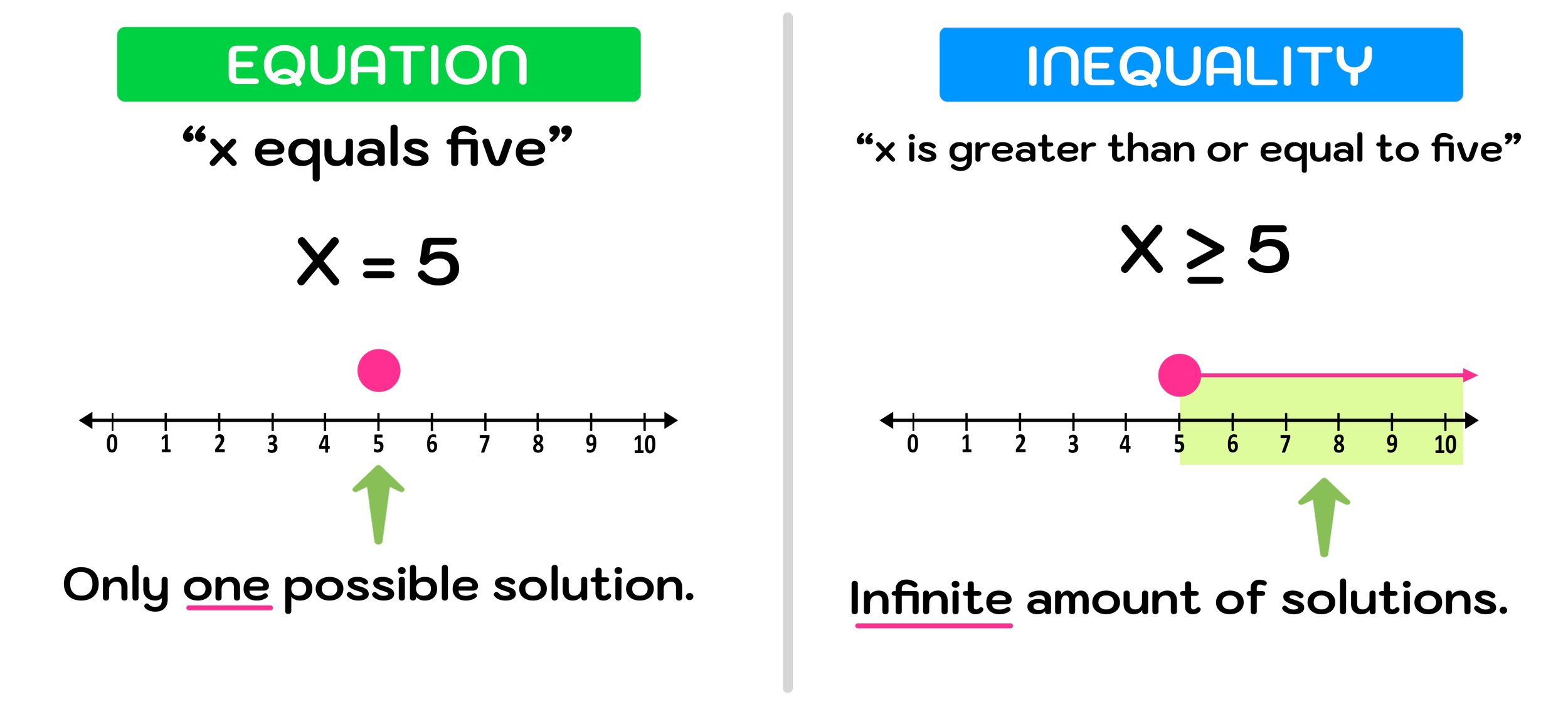
So, you think you're a math whiz, huh? Well, let's get down to business and talk about something that's really important in the world of numbers: the difference between an equation and an inequality. It's like the difference between being exactly on time for a date and being fashionably late – one is precise, while the other is, well, a bit more flexible.
In simple terms, an equation is like a perfect match, where two things are equal, like 2 + 2 = 4. It's a statement that says two expressions have the same value, and it's often represented by an equal sign (=). On the other hand, an inequality is like a comparison, where one thing is greater or less than another, like 2 + 2 < 5.
The Equality Sign
The equality sign (=) is like a referee in a math problem, declaring that both sides are equal. It's a powerful symbol that says, "Hey, these two things are the same, so don't even think about arguing with me!" When you see an equation with an equality sign, you know that the two expressions on either side have the same value. For example, 2x + 3 = 7 is an equation that says the expression 2x + 3 has the same value as 7.
Must Read
- Ross Return Policy: Bargain Hunting Reality: Can You Return Clearance Finds Without The Tag At Ross?
- Alaska Airlines Baggage Policy: Overhead Squeeze: Are You Accidentally Over The Limit On Alaska Airlines Flights?
- Dicks Return Policy: Tested On The Field: Does Dick’s Sporting Goods Really Let You Return Used Gear?
But, what happens when you have a math problem that doesn't have an equal sign? That's where inequalities come in – they're like the cool, laid-back cousin of equations. Inequalities use symbols like <, >, ≤, or ≥ to compare two expressions, and they're often used to describe real-world situations, like "I want to spend less than $50 on dinner" or "I need to run more than 3 miles to get in shape".
Inequalities: The Flexible Friend
Inequalities are like the flexible friend who's always willing to compromise. They don't require an exact match, but rather a range of values that satisfy the condition. For example, the inequality 2x + 3 > 7 says that the expression 2x + 3 must have a value greater than 7, but it doesn't specify exactly what that value is. It's like saying, "Hey, just be more than 7, and we're good!"
 Difference between Equations & Inequalities (Important) | Math | ShowMe
So, why do we need both equations and inequalities? Well, equations are great for solving problems that require an exact answer, like finding the area of a circle or the length of a side in a triangle. But, inequalities are perfect for modeling real-world situations that involve uncertainty or flexibility, like predicting the weather or determining the best price for a product.
Surprisingly, inequalities have a lot of practical applications in our daily lives. For instance, they're used in finance to determine the best investment strategies, in engineering to design safe and efficient systems, and even in gaming to create more realistic simulations. Who knew that inequalities could be so cool?
 Graphing Inequalities 2.8 >,≤,
Real-World Examples
Let's consider a real-world example to illustrate the difference between an equation and an inequality. Suppose you're planning a road trip from New York to Los Angeles, and you want to know how long it will take to get there. If you assume a constant speed of 60 miles per hour, you can use an equation to calculate the exact time it will take: time = distance / speed. But, if you want to account for traffic, road conditions, and other factors that might affect your journey, you can use an inequality to estimate the time: time > distance / speed. This way, you'll have a more realistic idea of how long your trip will take.
Another example is in medicine, where doctors use inequalities to determine the appropriate dosage of a medication for a patient. They need to consider factors like the patient's weight, age, and medical history to ensure that the dosage is safe and effective. This is where inequalities come in – they help doctors find the right range of values for the dosage, rather than a single exact value.
 Unit 4: 1-Step Equations & Inequalities - Lindley Sixth Math
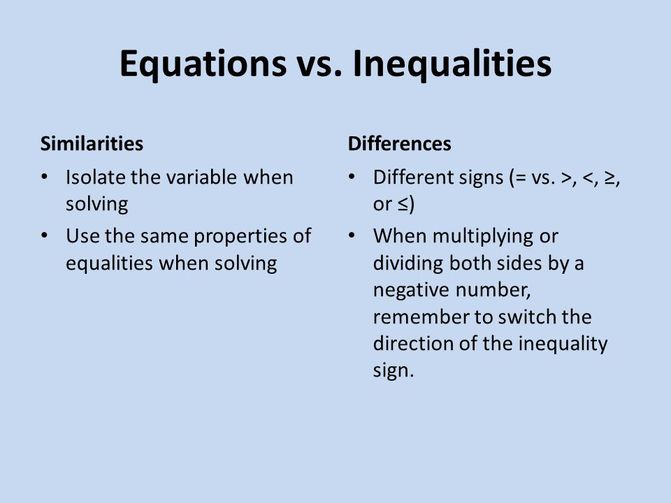
In conclusion, the difference between an equation and an inequality is like the difference between a precise recipe and a flexible guideline. While equations require an exact match, inequalities offer a range of values that satisfy the condition. By understanding the difference between these two concepts, you'll become a master of math and be able to tackle even the toughest problems with confidence. So, go ahead and flex your math muscles – you never know when you'll need to solve an equation or inequality in real life!
And, as a final note, remember that math is all around us, even in the most unexpected places. So, next time you're out with friends, trying to decide how to split the bill, just think of it as a fun math problem – and use your knowledge of equations and inequalities to figure out who owes what. Trust us, your friends will be impressed!
So, there you have it – a brief tour of the wonderful world of equations and inequalities. We hope you had fun learning about these two math concepts and that you'll continue to explore the amazing world of mathematics. Who knows, you might just discover a new passion for math!
